
How to dress professionally for women comes down to one thing: looking intentional, credible, and appropriate for your workplace, without feeling like you’re wearing a costume.
If you’ve ever stood in front of the closet wondering whether something is “too much,” “too casual,” or “too corporate,” you’re not alone. Dress codes are rarely written clearly, and even when they are, the real rules live in people’s expectations.

This guide gives you practical outfit formulas, a fast self-check, and a simple planning method so you can dress with less second-guessing, even if your office culture feels ambiguous.
What “professional” actually means (and why it varies)
Professional doesn’t always mean formal, it usually means you match the level of formality in your environment while staying polished. A tailored blazer can read “manager-ready” in one office and “overdressed” in another, both can be fine depending on context.
According to U.S. Equal Employment Opportunity Commission (EEOC) guidance on workplace appearance policies, dress codes can exist, but they should be applied consistently and without discrimination. In real life, that often translates to: aim for neutral, neat, and job-relevant, then adjust based on the norms you observe.
Use these three signals to decode expectations quickly:
- Industry: finance, law, government often skew formal; tech and creative often skew relaxed, but still expect clean lines and quality basics.
- Your role: client-facing and leadership roles usually require a sharper baseline than back-office roles.
- Your day: presentations, interviews, and new-team meetings typically call for a step up.
Start with a quick self-check before you buy anything
Most wardrobe stress comes from missing a baseline. Before you shop or overhaul, get clear on your “default professional” and your “step-up professional.”
Try this quick checklist the next time you build an outfit:
- Fit: nothing pulling at buttons, gaping, riding up, or needing constant adjusting.
- Fabric and finish: fewer wrinkles, minimal pilling, no visible wear at cuffs and collars.
- Opacity: tops and skirts pass natural-light tests, undergarments don’t show through.
- Balance: if one item is fitted or shorter, the rest looks more structured and covered.
- Footing: shoes look clean and intentional, even if they’re flats or sneakers allowed by policy.
- Message: you look like you’re here to do the job, not to test the limits of the dress code.
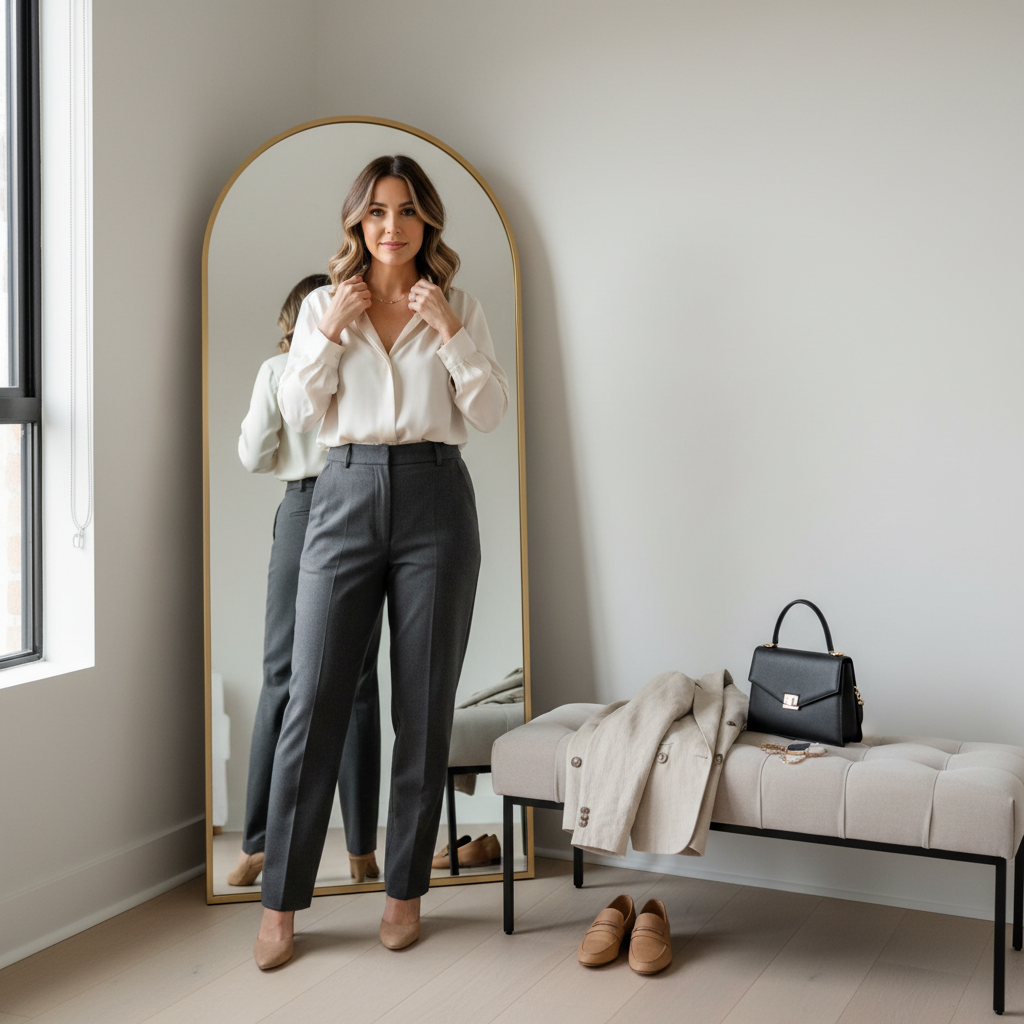
If you pass most of these without fussing, you’re usually in safe territory, even in mixed dress-code workplaces.
Professional dress levels: choose the right “lane”
When people ask how to dress professionally for women, they often mean “what lane am I in today?” Here’s a practical breakdown you can use without overthinking.
Business professional (more formal)
- Matching suit (pantsuit or skirt suit) or a structured dress with a blazer
- Closed-toe pumps or clean, minimal flats
- Neutral or muted colors, subtle prints
Business casual (most common in U.S. offices)
- Blouse or knit top + tailored pants, ankle pants, or a knee-length skirt
- Blazer, cardigan, or structured jacket as the “polish layer”
- Loafers, flats, low block heels, or office-appropriate sneakers where accepted
Smart casual (some tech/creative offices)
- Dark, clean denim may be acceptable, paired with a blazer or elevated top
- Simple dresses, elevated knits, clean-line separates
- Minimal sneakers or boots that look intentional and well-kept
Outfit formulas that work on repeat (with less decision fatigue)
Good work style is often a few reliable formulas repeated with small upgrades. If you’re building from scratch, start here and rotate colors and textures.
- Blazer + knit top + tailored pants: the easiest “instant professional” combo.
- Button-down + straight-leg trousers + loafers: crisp, especially for meetings.
- Sheath or midi dress + structured layer: add a blazer or a refined cardigan.
- Monochrome set (same color family): looks elevated even with simple pieces.
- Wide-leg trousers + fitted top + pointed flats: modern and office-safe if length is right.
Key point: if you’re unsure, add structure. A blazer, a sharper shoe, or a belt can “professionalize” an outfit fast.
Professional color, fit, and fabric: the quiet details people notice
In many workplaces, nobody comments on your blouse color, but people do notice when something looks overly casual, sheer, or sloppy. The easiest way to avoid that is to treat fit and fabric as your foundation.
Color guidelines that feel modern
- Safe neutrals: navy, charcoal, black, cream, camel, olive.
- Easy accent colors: burgundy, forest green, dusty blue, soft pink.
- Print rule of thumb: smaller, calmer prints read more professional than large, loud patterns.
Fit and proportions that read “work-ready”
- Hemlines often land around knee to midi in more traditional offices, but norms vary.
- Necklines sit comfortably when you lean forward, a quick test many people forget.
- If pants puddle on the floor or hike up when you sit, a quick hem or a different inseam solves a lot.
Fabric matters more than brand
- Look for ponte, wool blends, structured cotton, viscose blends, and higher-quality knits.
- Very thin jersey and clingy fabrics can look casual even when the cut is “office.”
- Wrinkle-prone pieces aren’t “wrong,” they just raise your maintenance load.
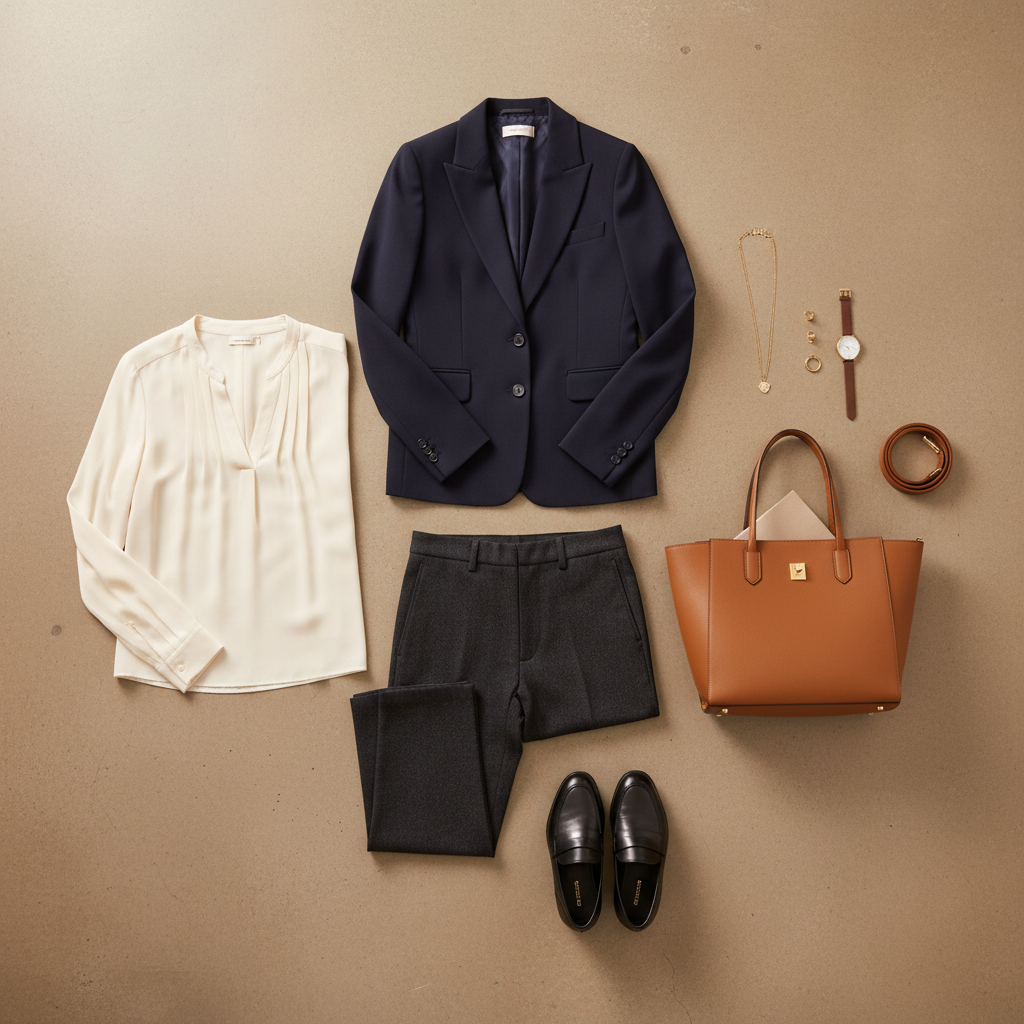
A simple professional wardrobe table (build a “capsule” without being boring)
You don’t need a massive closet to dress well at work. You need a small set of mix-and-match pieces that cover your real week, including laundry timing and weather shifts.
| Category | Start With | Why It Helps | Easy Upgrade |
|---|---|---|---|
| Blazer / Jacket | 1 neutral blazer (navy/black/charcoal) | Adds structure instantly | Second layer: cropped jacket or longline blazer |
| Tops | 3–5 tops (mix of blouse + refined knit) | Rotates easily across weeks | Add one subtle print or satin-like texture |
| Bottoms | 2 pairs tailored pants + 1 skirt (optional) | Anchors outfits, looks “work” | Try one modern cut: wide-leg or ankle-length |
| Dresses | 1 work dress in a solid color | One-and-done on busy mornings | Add a belt or second layering piece |
| Shoes | Loafers/flats + low heel (if you wear heels) | Comfort without looking casual | Polished ankle boot for fall/winter |
| Bag | Structured tote or backpack (clean design) | Looks intentional, carries laptop | Leather or coated canvas for durability |
Practical scenarios: what to wear (and what to avoid)
Even in offices with “no dress code,” there are moments when dressing up is the safer play. Keep a few scenario rules so you don’t have to renegotiate the standard every time.
Interview days
- Many candidates do well with a suit or a structured dress + blazer, even if the office is casual.
- Keep accessories minimal, let fit and grooming do the work.
- Avoid anything that needs constant adjusting, it distracts you.
Presentations, client meetings, leadership visibility
- Step one level above your daily baseline, not five levels above.
- Sharper shoe + blazer or refined jacket usually covers it.
Hybrid work and video calls
- Solid colors, structured knits, and simple necklines read well on camera.
- Busy prints can look strange on video, especially with compression.
Common “looks fine at home, weird at work” traps
- Ultra-thin leggings as pants in workplaces that expect tailoring
- Overly distressed denim when you’re not sure it’s accepted
- Very high heels you can’t walk confidently in
- Anything sheer without the right layering
Key takeaways and a realistic action plan
Key takeaways:
- Professional style is more about fit, fabric, and structure than about expensive labels.
- Choose the right dress level for your industry, role, and day.
- Use repeatable outfit formulas so mornings don’t turn into negotiations.
If you want to act on this today, pick one “default” outfit formula for normal days, then build one “step-up” look for interviews or client-facing moments. Take photos of both on your phone, it saves time when you’re tired.
And if you’re still unsure how to dress professionally for women in your specific office, ask one trusted coworker what “normal” looks like there, most people will answer more directly than you expect.